"Our City" Table Talks
What We Just Did
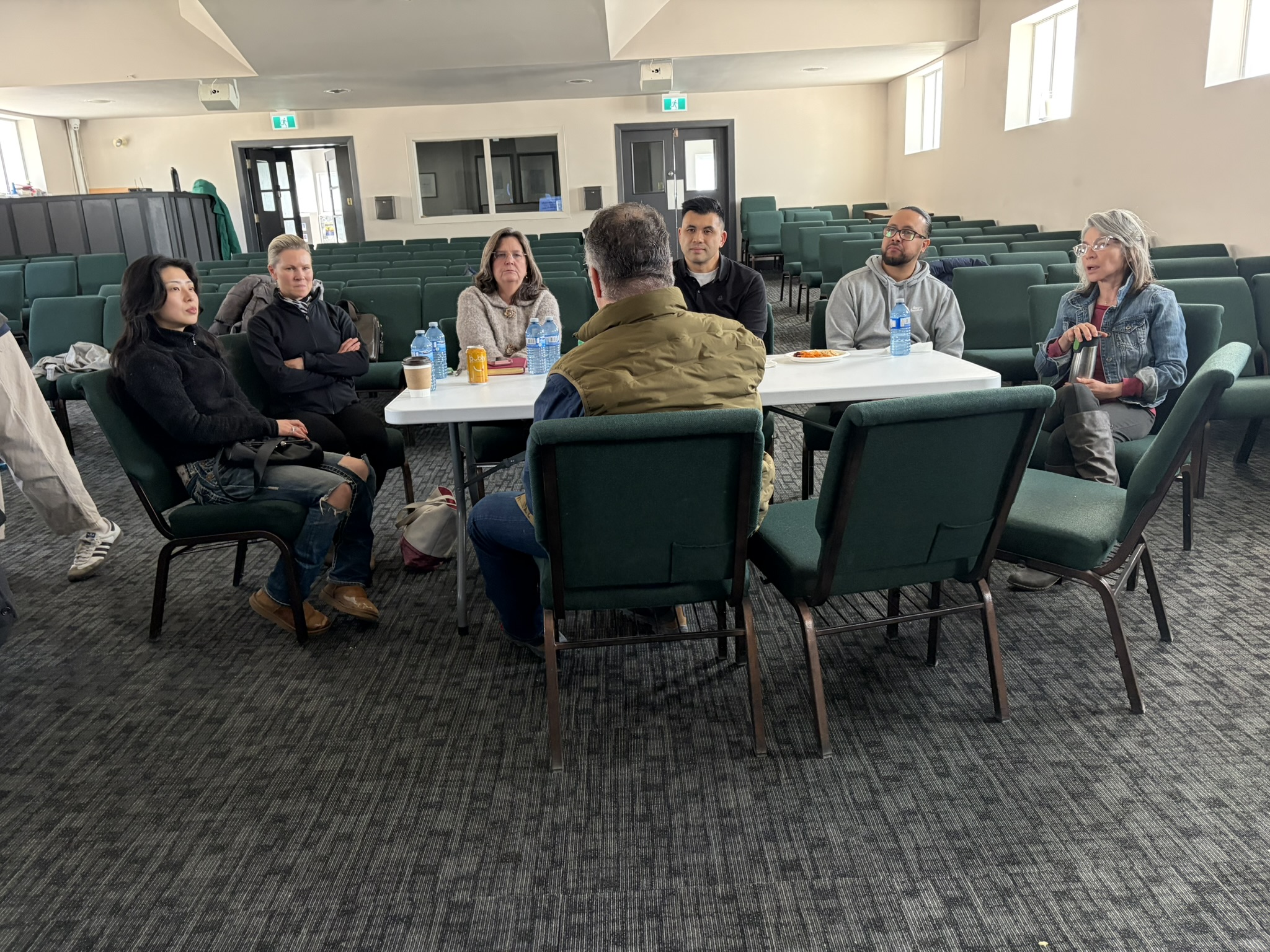
In January 2026, we hosted the first “Our City” gathering of this season at the Urban Ministry Hub at Stone Church’s Danforth campus.1 This urban hub is the culmination of an important and strategic partnership between Mission Canada and Stone Church, borne out of our shared love and passion for the city. In contrast to previous conference designs, we opted for smaller gatherings this season, intentionally creating a more intimate setting to facilitate more frequent meetings. This approach aims to foster more robust collaborative opportunities among fellow ministry leaders and practitioners within the city.
Our design was predicated on the idea that informal conversations during conferences and gatherings are sometimes our most meaningful interactions. While presentations and speeches deliver compelling content, they do not enable intimate, collaborative discussions among participants. This led us to consider the hypothesis that reverse-engineering this pattern might yield a different outcome. So, we allocated less time to formal presentations and intentionally designed longer periods for discussion, dialogue and collaborative conversations.
Collaboration is the main goal of our gatherings, as serving in the city can be overwhelming. Knowing that others are facing the same challenges and are still passionate about their work, gives us strength and perhaps creates a conduit for us to share knowledge, resources and insights for the betterment of each other.
We were pleased to host our first event, where over 20 urban ministry leaders shared a meal, spent 20 minutes on a macro-level report on statistical patterns in the city, and then spent over 90 minutes in facilitated dialogue. Conversation was our means of sharing ideas, laughter and connection. The thematic premise of our gathering was to affirm that there is a resource deficiency in all our ministry contexts. However, rather than praying for a multi-million-dollar donation to resolve our issues, perhaps we could circumvent this deficiency by collaborating and sharing resources. This conclusion informed the theme of our upcoming gathering in May, during which we will conduct a grant writing workshop to enhance our capacity to identify alternative financial resources for our respective ministries.
How It Started
In 2017, I attended my first Christian Community Development Association annual conference in Detroit, Michigan, with Kevin Rogers, urban ministry practitioner and founding pastor of New Song Church in Windsor, Ontario. We couldn't help but notice the fellow urban ministry practitioners, dedicated to serving their neighbourhoods and communities with incredible fervour, enthusiasm and creativity. It was a delight and honour to be in a room with practical standers who felt like fellow kin in our ministry work. The workshops and presenters were inspiring as they courageously shared their stories, both of lament and triumph, in their respective spheres of ministry, all tethered around their work within the city. After attending this gathering, we were inspired to ask ourselves: could we do the same thing in Canada? This led to the first gathering of "Our City" Toronto in 2019, where over 130 delegates from different ministry spheres gathered at Stone Church. We had leaders from different denominations, non-profit leaders, pastors and lay leaders, all gathering around our passion for the city. Through the years, we have produced several events in Toronto, with other cities now beginning their own gatherings to celebrate ministry practitioners within their context, and again, gathering over the shared love and passion for their cities.
Again, I Say, Cities Matter
This narrative of ministry, partnership and collaboration within cities is not a new phenomenon, but is arguably an echo of the early church. In a previous article,2 I talked about our Fellowship, the PAOC, starting in the city, but this is not a unique pattern; in fact, it is eerily sinilar to the early church. Several scholars attest to this, including Wayne Meeks in his book The First Urban Christians, who argues that the early church's character, strategy and rapid expansion were shaped by the social and physical infrastructure of the Roman provincial metropolis.3 Cities, in essence, provided a conducive environment for growth in the early church, frequently serving as venues for dialogue, the exchange of innovative ideas, and exemplifying diversity as meeting points for various groups. But often we forget that the early church’s humble beginnings were in houses within these cities, rather than in specialized buildings, where they shared their faith and worship, a model that is ironically and possibly the kind of church community that people need. I say this because, apart from our own findings in the stories shared by our neighbours and local social media groups, a recent sociological study found that Toronto is one of the loneliest places in Canada.4 This is perhaps also the impetus for our own shift in thinking about our gatherings, where, instead of aiming to grow bigger, we would rather model and exemplify the intimacy, friendship and collaboration that our city desperately needs.
Contextual Multiplication
Since the launch of “Our City” in Toronto, the event has expanded to other cities. Kevin Rogers spearheaded the “Our City” gathering in Windsor, Ontario, in 2024, and my friend Zach Manntai led a gathering in Calgary, Alberta, in 2025. Each gathering was uniquely tailored to its ministry context, under the vision of a local ministry leader/practitioner rather than following the framework of our Toronto gatherings. Instead of a franchise model of ministry, we believe in being an incubator for ideas where each gathering is a manifestation of local imagination, inspiration and relationships. As we dream of other cities having their own gatherings, we believe this contextualized approach is a sustainable model for others to adopt, as we learn to share ideas and inspiration with an open hand rather than holding them close to our chests, driven by fear or scarcity. And if we, as Christians, can be models of collaboration, relationship and radical generosity towards one another, this will be an undeniable sign of the Spirit at work and a model of connectedness in our weary and lonely world.
The Power of Small
In the past, I was lured by the idea that success in ministry is manifested in large gatherings. I have since shifted away from this ethos as I now begin my 20th year of ministry and of living in Toronto’s downtown core, where I’ve realized that powerful and transformative movements begin small. With a Pentecostal worldview, we often focus on the birth of the church through the outpouring of the Holy Spirit (see Acts 2) and on Peter preaching with conviction and power. Yet, before this event, Jesus intentionally gathered an odd bunch of disciples to walk alongside Him for three years, at times withdrawing from crowds (Mark 6:31-32, 46-47) and at other times sharing a lesson so radical that people felt compelled to walk away (John 6:66). I mention this not to shame large gatherings but perhaps to highlight the possibility that, by deeming “large” as a measure of success, we in turn could dismiss the power of “small.” Small gatherings are incredible environments for intimacy and relationship building. They are spaces for dialogue and negotiation through our agreements and disagreements. And perhaps, as our current social media- and technology- driven society has shifted how we interact with one another, small gatherings could be the antidote to the disjointedness we are seeing in our world. Or perhaps, as I have silently admitted, I dream of the Holy Spirit showing up in many small gatherings to see what transformative effect this could have in neighbourhoods and communities.
[1] "Urban Ministry Hub," Our City Toronto, accessed January 30, 2026, www.ourcitytoronto.ca.
[2] Earnest John "Ejay" Tupe, "Our Cities Matter: Facing the Opportunity and the Challenge," testimony/Enrich, October/November/December 2024, https://testimony.paoc.org/articles/our-cities-matter.
[3] Wayne A. Meeks, The First Urban Christians: The Social World of the Apostle Paul, Second Edition (Yale University Press, 2003), 9-11.
[4] Breanna Marcelo, “Toronto Is One of the Loneliest Places in Canada: Report,” Now Toronto, November 15, 2023, https://nowtoronto.com/news/toronto-is-one-of-the-loneliest-places-in-canada.
